
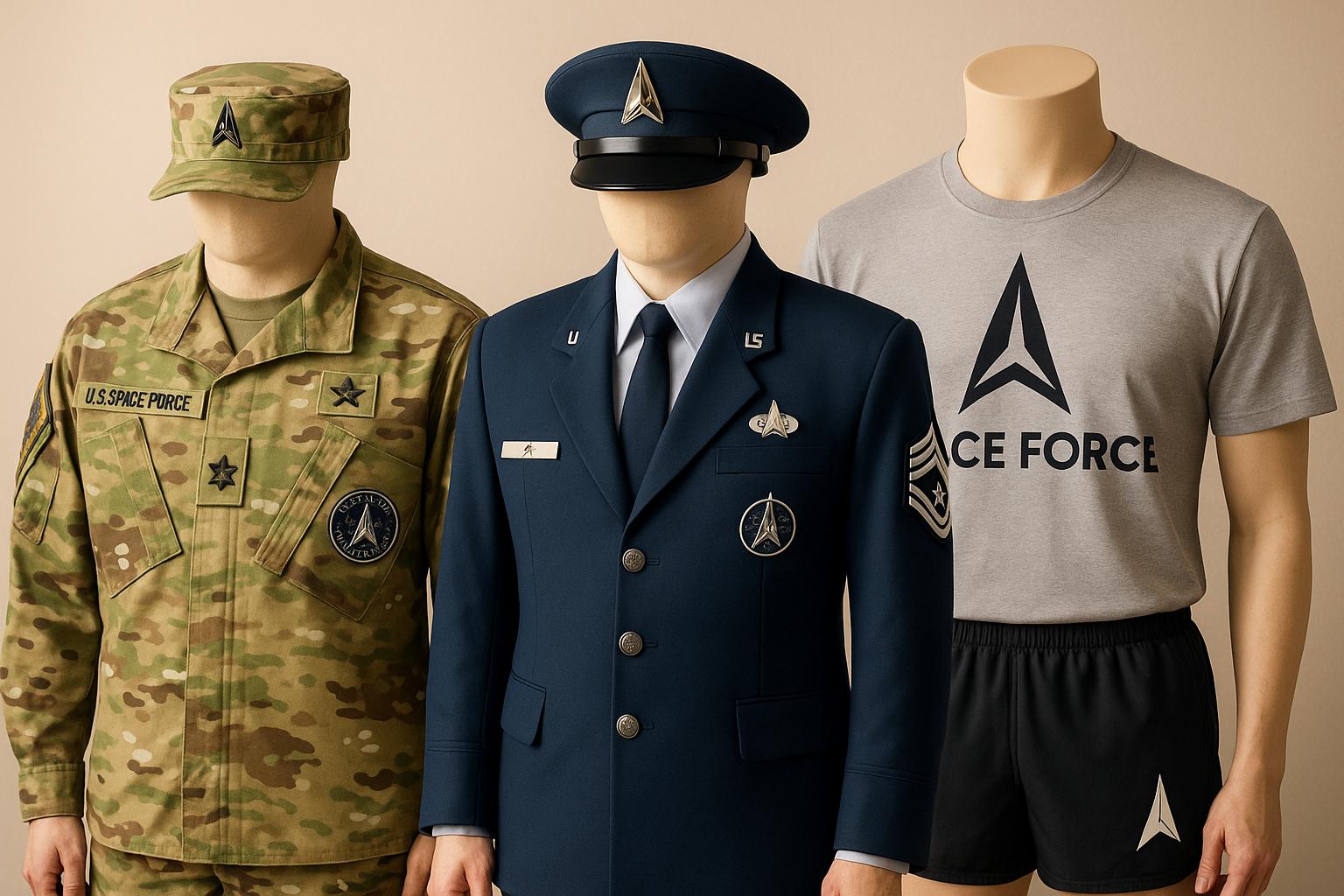
The United States Space Force (USSF), established on December 20, 2019, has introduced distinct uniforms that reflect its mission to protect U.S. interests in space. Guardians, as Space Force personnel are called, follow specific dress and grooming standards outlined in Space Force Instruction 36-2903 (SPFI 36-2903), which became effective on August 14, 2025. Here’s what you need to know:
Key Highlights:
- Uniform Types:
- Operational Camouflage Pattern (OCP) for daily tasks, featuring Space Blue embroidery and a full-color U.S. flag.
- Service Dress Uniform for formal events, with midnight blue fabric and silver buttons engraved with the Space Force seal.
- Physical Training (PT) Gear for fitness activities, featuring the Space Force emblem.
- Grooming Standards:
- Men’s hair: Up to 2.5 inches from the scalp; women’s hair: Up to 4 inches in bulk.
- Beards: Prohibited unless medically or religiously exempt.
- Tattoos and piercings: Allowed within specific guidelines (e.g., no extremist or offensive designs).
- Mission Tabs:
- Guardians can wear tabs identifying roles like orbital warfare, missile tracking, and satellite communications, positioned on the OCP uniform.
- Differences from Air Force:
- Space Force uses Space Blue embroidery (vs. Air Force’s spice brown).
- Mission tabs and insignia placement are tailored to Space Force identity.
Why It Matters:
Uniform compliance ensures Guardians and cleared professionals maintain a professional appearance, reinforcing the Space Force’s values and mission. SPFI 36-2903 consolidates all dress and grooming guidelines, making it the definitive resource for personnel and contractors working within or alongside the Space Force.
For more details, consult SPFI 36-2903 or your chain of command.
New SPACE FORCE SERVICE DRESS UNIFORMS REVEALED
SPFI 36-2903: Space Force Uniform Regulations
Space Force Instruction 36-2903 (SPFI 36-2903) is the Space Force’s first official dress and appearance policy, tailored specifically for Guardians. This comprehensive 114-page guide became effective on August 14, 2025, and consolidates all uniform and grooming standards into one authoritative document [3][4]. For Guardians and those working closely with the Space Force, it serves as the go-to resource for maintaining a professional military image.
The policy emphasizes neatness, cleanliness, safety, uniformity, and projecting a professional appearance. While it draws heavily from Air Force regulations – reflecting the Space Force’s origins – it includes key differences that highlight the unique identity of Guardians.
Main Requirements of SPFI 36-2903
SPFI 36-2903 covers every detail of uniform wear and personal grooming, from hairstyle guidelines to insignia placement. For Guardians, contractors, and civilian employees alike, understanding these standards is essential for compliance and professionalism.
Grooming standards are a major focus. Men’s hair can extend up to 2 1/2 inches from the scalp, while women’s hair is allowed up to 4 inches in bulk [3]. Hairstyles are flexible but must maintain a professional military look [3]. Tattoos and body piercings are permitted within the guidelines [3]. Female service members are restricted to muted nail polish colors, and eyelash extensions must adhere to length regulations to ensure a professional appearance [3]. Beards remain prohibited unless a medical or religious waiver is granted [2][3]. These grooming rules set the foundation for more detailed uniform and insignia specifications.
Insignia and mission identification are also key elements of the policy. Guardians can now wear mission tabs that highlight their specific roles. These tabs are positioned above the organizational unit patch and below the Commander’s Badge Insignia, if applicable [2][3][4]. Made of PVC, these tabs must follow Space Blue color guidelines on an Operational Camouflage Pattern (OCP) background and fit within the designated Velcro area [3].
Approved mission tabs include "OW" for orbital warfare, "MWT" for missile warning and tracking, as well as tabs for electromagnetic warfare, cyberspace warfare, satellite communications, navigation warfare, space-based sensing and targeting, and satellite control [3][4]. These identifiers not only promote unit pride but also highlight the specialized roles of Guardians.
Uniform components are extensively detailed in SPFI 36-2903. The OCP uniform, the daily duty attire for most Guardians, features Space Blue embroidery for name tape, branch tape, and rank, creating a distinct look that sets Space Force personnel apart [1]. The full-color U.S. flag is worn on the left side [1].
The policy also includes guidance for the Space Force’s interim service dress uniform. This uniform retains key elements of the Air Force dress blues but incorporates unique Space Force details such as silver "Hap Arnold wings" buttons, mirror-silver "U.S." insignia on collars, and the U.S. Space Force lapel insignia [1]. A silver name tag with blue detailing is worn on the right side, while ribbons and occupational badges are displayed on the left [1].
Differences from Air Force Regulations
While SPFI 36-2903 builds on the Air Force framework, it introduces unique elements that reinforce the Space Force’s identity. These distinctions are especially important for professionals working across branches or transitioning between services.
Hair and grooming policies show subtle but meaningful differences. For instance, the Air Force requires male Airmen’s hair to stay off the ears and mandates a clean-shaven appearance at the start of each duty day – language absent from the Space Force policy [3][4]. Though both branches prohibit beards without a waiver, the Space Force provides Guardians with slightly more flexibility in their daily grooming standards [2][3].
Mission tabs and patches are another area of distinction. While the Air Force limited duty identifier patches to a dozen approved designs as of February 1, 2025, the Space Force allows a broader range of mission tabs, giving Guardians more opportunities to represent their specific fields [2][3][4]. Additionally, Space Force personnel can wear the "first sergeant" duty identifier patch and certain mission area patches, which the Air Force has restricted [2].
Service dress uniform details further differentiate the two branches. Although the Space Force interim service dress uniform was inherited from the Air Force, it features distinct elements like buttons embossed with the Space Force insignia and the U.S. Space Force lapel insignia [3][1].
On the OCP uniform, the differences are immediately noticeable. The Air Force uses spice brown embroidery and places a subdued spice brown flag on the right arm [1]. In contrast, the Space Force opts for Space Blue embroidery and a full-color flag on the left side [1]. These design choices make Space Force personnel instantly recognizable in joint operational settings.
For professionals working in Space Force environments or on Space Force contracts, recognizing these distinctions shows an understanding of service culture and attention to detail – qualities essential in national security roles. Familiarity with SPFI 36-2903 ensures that individuals meet the high standards expected when collaborating with Guardians on classified missions or attending meetings at Space Force facilities.
Space Force Uniform Types and Components
Based on SPFI 36-2903 standards, the United States Space Force has developed three main uniform categories to meet the specific needs of its personnel: the Operational Camouflage Pattern (OCP) uniform for daily duties, the service dress uniform for formal occasions, and physical training (PT) gear for fitness activities. Each uniform is designed to balance functionality with a professional appearance, tailored to the unique demands of Space Force roles.
Operational Camouflage Pattern (OCP) Uniform
The OCP uniform is the everyday attire for Guardians, adhering to SPFI guidelines. It includes embroidered branch identifiers, rank insignia, and affiliation markers, with optional mission tabs for specialized roles. This design not only ensures clear identification in joint operations but also aligns with the professional military image required for personnel working in high-security environments.
Service Dress Uniform
The service dress uniform is reserved for ceremonial events, official gatherings, and other professional settings. The interim version combines elements of Air Force heritage with Space Force-specific touches, featuring a tailored dark coat and trousers, distinctive lapel insignia, and accessories like ribbons, occupational badges, and a name tag. These elements are arranged to meet military standards, creating a polished and formal look. Meanwhile, a new service dress uniform is in development, aiming to better reflect the Space Force’s distinct identity and its dedication to excellence.
Physical Training Gear and Outerwear
The PT uniform is crafted to provide a cohesive and professional appearance during fitness activities and in adverse weather. It typically includes a shirt, athletic shorts or pants, and approved athletic footwear – all featuring the Space Force emblem. Outerwear, such as jackets and standard headgear like patrol caps, is worn according to specific guidelines, ensuring personnel remain identifiable and maintain consistency with the branch’s uniform standards, even during physical training sessions.
sbb-itb-fdb084f
Grooming and Appearance Standards
The Space Force’s SPFI 36-2903 outlines grooming and appearance standards to ensure every Guardian embodies the core values of the organization. These updated guidelines aim to maintain a professional image across all Space Force operations.
Katharine Kelley, Deputy Chief of Space Operations for Personnel, stated: "Every Guardian’s military presence and appearance are a critical and visible demonstration of our professional force, and this new policy provides clear standards that support our warfighting objectives and culture."[2]
These grooming standards complement uniform regulations, ensuring a cohesive and professional military appearance for all Guardians.
Hair and Facial Hair Requirements
The updated hair standards in SPFI 36-2903 promote a neat, professional look while offering more flexibility than earlier guidelines. For example, the previous Air Force rule that prohibited hair from touching the ears is no longer included[2]. However, Guardians are still expected to maintain hairstyles that reflect military professionalism.
Facial hair regulations remain stricter. Beards are not allowed unless a Guardian has an approved medical profile or a religious accommodation waiver[2]. Otherwise, Guardians must maintain a clean-shaven appearance.
Tattoos and Body Modifications
The Space Force’s tattoo and body modification policies align closely with Air Force standards. When SPFI 36-2903 became effective on August 14, 2025, it introduced clear guidelines balancing personal expression with a professional military image[3].
Tattoos, including those on the neck, are permitted under the policy. However, tattoos must not contain extremist, indecent, sexist, or racist content. Designs that advocate discrimination based on sexual orientation, race, ethnicity, or religion – or those depicting obscene or violent imagery – are strictly prohibited. Tattoos on the face, tongue, lips, and eyelids remain banned.
The rules for body piercings are also consistent with Air Force standards[3]. Female Guardians may wear conservative earrings while in uniform, but male Guardians are not permitted to wear earrings. Other visible piercings, such as nose rings, eyebrow piercings, and tongue piercings, are not allowed during official duty.
Recent updates have also introduced limits on nail polish colors for female Guardians and specified maximum lengths for eyelash extensions, aligning with Air Force regulations[3]. These details ensure that grooming choices support a polished and professional appearance.
For further clarification, Guardians are encouraged to review these policies or consult their chain of command. Upholding these grooming and appearance standards is just as important as maintaining uniform integrity.
Maintaining Compliance as a Cleared Professional
For security-cleared professionals working in Space Force operations, maintaining compliance with uniform regulations is essential. Whether you’re a Guardian, a contractor supporting Space Force missions, or a cleared professional in a joint defense role, adhering to SPFI 36-2903 is key to meeting operational expectations and maintaining credibility.
The adoption of SPFI 36-2903 on August 14, 2025, marked a turning point for the Space Force. It established its own dress and appearance policy, moving away from the Air Force regulations it had previously followed[3][2]. For cleared personnel, this shift means staying informed about Space Force-specific standards instead of relying on past practices. Let’s explore how to consistently meet these guidelines and maintain a professional appearance in defense roles.
Meeting Uniform Standards
Before participating in Space Force operations or entering its facilities, cleared professionals must ensure they meet all uniform requirements outlined in SPFI 36-2903. This comprehensive instruction covers everything from uniform components and insignia placement to grooming standards and authorized accessories.
For contractors and civilians, it’s crucial to confirm any dress code requirements with your program manager or security officer. While some roles may require military-style uniforms, others may follow professional civilian dress standards tailored to the Space Force environment.
To stay compliant, maintain documentation of uniform-related guidance specific to your assignment. This could include memorandums or supplemental instructions from your command, which often clarify requirements for specialized roles or temporary duty assignments. Regularly review these documents, especially if transitioning from another service branch, as differences in regulations may require adjustments.
Take a proactive approach to compliance by keeping updated uniform guidance on hand and conducting regular self-inspections. Ensure your uniform fits properly, is clean, and remains serviceable. Check that insignia, patches, and badges are correctly positioned according to the latest specifications. Replace any worn or damaged items promptly to maintain a polished and professional appearance.
Professional Appearance in Defense Roles
Uniform compliance is just the starting point. A professional appearance plays a critical role in building trust and confidence within defense and intelligence sectors. For cleared professionals, adhering to dress codes isn’t merely about following rules – it’s about demonstrating respect for the mission, your colleagues, and the values of military culture.
In high-security roles, attention to detail in your appearance reflects your broader discipline and reliability. Senior leaders often form their impressions based on how you present yourself. A Guardian or cleared professional who consistently meets uniform standards communicates a sense of responsibility and precision – qualities that are indispensable in national security roles.
The Space Force operates in highly technical and sensitive areas where precision is a must. When you display care in your personal appearance, it signals that you approach classified information and critical systems with the same level of diligence. This is especially important when working with interagency partners or international allies who may not be as familiar with Space Force culture.
For civilians and contractors, understanding military uniform standards is equally important. Uniform regulations are deeply rooted in military traditions of discipline, uniformity, and shared identity. By respecting these standards, even as a civilian, you foster stronger working relationships and demonstrate cultural awareness.
Your appearance also influences your career trajectory. Supervisors and program managers notice who consistently meets standards and who doesn’t. For cleared professionals seeking advancement or new opportunities within the Space Force, a track record of professionalism can set you apart from equally qualified candidates.
In roles that involve external representation – such as briefing senior leaders, collaborating with other agencies, or participating in public-facing events – your appearance becomes even more critical. You’re not just representing yourself; you’re representing the Space Force as a whole. Proper adherence to dress standards ensures you project the level of professionalism the organization expects.
Finally, staying adaptable to policy changes demonstrates your commitment to the Space Force’s evolving standards. As the newest branch of the military, the Space Force continues to refine its regulations. Cleared professionals who stay informed about updates to SPFI 36-2903 and implement changes promptly show they’re engaged with the organization’s growth and dedicated to maintaining excellence.
For those working in joint environments with other military branches, understanding Space Force-specific standards is equally important. Differences in dress and appearance policies between the Space Force, Air Force, Army, Navy, and Marine Corps can arise. Being knowledgeable about these distinctions allows you to remain compliant while respecting the unique culture of each service.
Conclusion: Space Force Uniform Compliance for Cleared Personnel
Uniform compliance isn’t just about following rules – it’s about embodying the values and mission of the Space Force. Here’s why maintaining these standards matters and how cleared personnel can stay on track.
Why Uniform Regulations Matter
Uniform regulations play a crucial role in reflecting the Space Force’s mission and projecting a professional military image. As outlined in SPFI 36-2903 and detailed in uniform component guidelines, these standards are integral to operational readiness and professionalism.
For cleared personnel, adhering to SPFI 36-2903 is more than a requirement – it’s a visible commitment to the Space Force’s mission and culture. Katharine Kelley, Deputy Chief of Space Operations for Personnel, put it best:
"Every Guardian’s military presence and appearance are a critical and visible demonstration of our professional force, and this new policy provides clear standards that support our warfighting objectives and culture." [2]
Even contractors and civilians who align with these standards demonstrate respect, professionalism, and an understanding of Space Force values.
Staying Current with Space Force Policies
As the Space Force evolves, so do its policies. Staying up-to-date with SPFI 36-2903 and related guidance is essential for maintaining the high standards expected in defense roles.
- Regular Updates: Keep an eye on official Space Force channels for any policy changes.
- Seek Clarification: Reach out to program managers, security officers, or military liaisons for guidance on how updates apply to your role.
- Understand the Differences: If you’re transitioning from another branch or civilian role, take the time to review SPFI 36-2903 to understand how Space Force standards differ.
Maintaining compliance is an ongoing effort. Regularly inspect your uniform, replace worn items promptly, and stay informed about policy changes. By doing so, you not only uphold your professional appearance but also contribute to the overall strength and precision of the Space Force in its mission to support national defense.
FAQs
What sets Space Force uniforms apart from Air Force uniforms, and why are these differences important?
The Space Force uniforms are designed to make a statement, blending distinctive style with meaningful symbolism. The new service dress uniform features a dark blue jacket with offset buttons and a band collar, giving it a modern, space-focused look that aligns with the branch’s forward-thinking mission. For now, the interim service dress draws from the Air Force’s design but includes Space Force insignia to set it apart.
These design choices aren’t just about aesthetics – they highlight the Space Force’s unique role within the U.S. military. The uniforms help build a sense of pride and professionalism among its members while making their identity clear during joint missions and public appearances.
What are the uniform guidelines for contractors and civilians working with the Space Force?
The Space Force enforces clear and detailed guidelines to maintain uniformity among contractors, civilians, and Guardians. These rules are laid out in Space Force Instruction 36-2903, which outlines expectations for dress, grooming, and overall personal appearance.
When necessary, civilians and contractors are expected to follow these standards to uphold a professional image and align with Space Force operations. For specific details, individuals should review their organization’s policies or refer directly to the Space Force regulations.
What are the Space Force’s policies on tattoos and piercings, and how do they fit into the overall grooming standards?
The United States Space Force has clear guidelines for tattoos and piercings to maintain a professional and consistent appearance among its members. These rules are detailed in Space Force Instruction (SPFI) 36-2903, which covers dress and personal appearance standards. Tattoos are generally allowed, but they must adhere to specific criteria: they cannot be offensive, extremist, or conflict with uniform regulations. Tattoos on the face, neck, or hands are mostly prohibited, though there are exceptions for small, discreet designs, such as a single ring tattoo on one finger.
Piercing policies are equally specific to ensure a polished and professional look. For instance, men in uniform are not allowed to wear earrings, while women may wear only one pair of small, conservative earrings. Visible body modifications or additional piercings that undermine the uniform’s appearance are not permitted. For the most precise and up-to-date details, refer to the official Space Force grooming and appearance standards.